Sri Lanka Journal of Social Sciences and Humanities
The Sri Lanka Journal of Social Sciences and Humanities (SLJSSH) is open access, double-blind peer-reviewed scholarly journal in the field of Social Sciences and Humanities. It is published twice a year (February and August).
Overview
About
The Sri Lanka Journal of Social Sciences and Humanities (SLJSSH) is open access, double-blind peer-reviewed scholarly journal in the field of Social Sciences and Humanities. It is published twice a year (February and August).
Aims & Scope
The Sri Lanka Journal of Social Sciences and Humanities (SLJSSH) aims to publish scholarly work by promoting multi-disciplinary studies in Social Sciences and Humanities. SLJSSH is not restricted to a specific research paradigm and welcomes submissions adopting a variety of methodologies and methods: quantitative, qualitative, and mixed. It provides the national and international scholars with an intellectual platform for the publication in a quality journal. It publishes high-quality original articles based on any aspects of theoretical, conceptual, empirical, or case-based research that contribute to the advancement of knowledge in all areas of Social Sciences and Humanities.
Publisher
SLJSSH is published by the Faculty of Social Sciences and Languages, Sabaragamuwa University of Sri Lanka. SLJSSH does not charge any submission, processing, or publication fees
Editorial Team
Editor in Chief
Department of Economics and Statistics, Sabaragamuwa University of Sri Lanka
Coordinating Editor
Department of Economics and Statistics, Sabaragamuwa University of Sri Lanka
Editors
Prof. W.M. Ariyaratne, Department of Languages, Sabaragamuwa University of Sri Lanka
Prof. R.J.M. Uduporuwa, Department of Geography and Environmental Management, Sabaragamuwa University of Sri Lanka
Dr. H.U.S. Pradeep, Department of Social Sciences, Sabaragamuwa University of Sri Lanka
Text Editor
Editorial Assistant
Editorial Guidelines
- Editors should be accountable for everything published in the journal: this includes having measures in place to assess the quality of the material they accept for the journal and a willingness to publish corrections and clarifications when required.
- Editors should act in a fair and balanced way when carrying out their duties, without discrimination on grounds of gender, ethnicity, sexual orientation, or religious or political beliefs.
- Editors should guide authors and reviewers on everything that is expected of them.
- Editors should make decisions on which articles to publish based on quality and suitability.
- Editors should handle submissions in a fair, unbiased, and timely manner and treat all manuscripts as confidential, for distribution to others for purposes of peer-review only.
- Editors should have systems to ensure that peer reviewers’ identities are protected unless they use an open review system that is declared to authors and reviewers.
- Journal should have policies and systems in place to ensure that commercial considerations do not affect editorial decisions, and editors should handle submissions for funded issues in the same way as for standard issues so that articles are accepted entirely on their academic merit and without commercial influence.
- Journals should have a declared mechanism for authors to appeal against editorial decisions.
- Editors should have systems for managing their conflicts of interest as well as those of their staff, authors, reviewers, and editorial board members
Volumes & Issues
Browse published volumes to access individual issues and flipbooks.
Volume 5
Published 2025
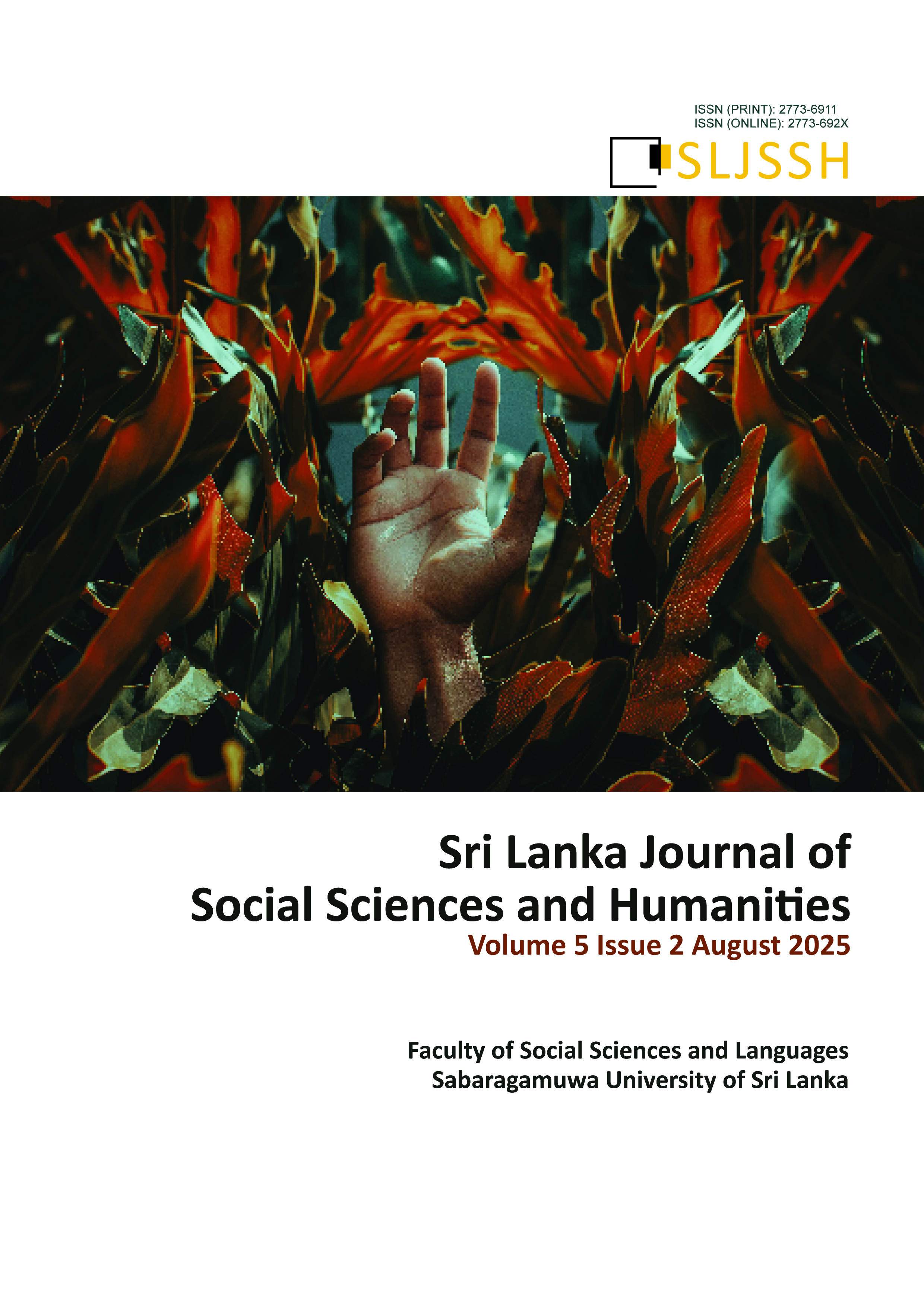
No description provided for this volume yet.
Quick Facts
- Total Volumes: 1
- Total Issues: 1
- Total Articles: 1
Key Policies
Article Withdrawal Policy
The articles submitted to the journal can be withdrawn either by the submitted authors. The article can be withdrawn at any time before it is published officially. If the authors want to withdraw the article, we insist on a signed statement from all the co-authors to the journal’s editorial office via mail. If the editorial office/ publisher finds any violation in publishing ethics, guidelines, duplicate submission, plagiarism, etc., publishers hold the right to withdraw/ reject the manuscript at any stage of the publishing process.
Plagiarism Policy
The Sri Lanka Journal of Social Sciences and Humanities has a Zero tolerance policy towards plagiarism. All articles are scanned through Turnitin. Turnitin receipt will be provided to authors with review reports. Authors are requested to check plagiarism at their end also to avoid any unpleasant situation. Please respect the work of other researchers by proper quotation and citation in your article. If any article is found plagiarized, it will not be published in this journal at any cost. The Editorial Board has passed the following actions:
Similarity Index above 30% - Article Rejected (NO RESUBMISSION accepted)
Similarity Index (15-30%) - Editor may send to the author for improvement
Similarity index Less than 15% - Maybe accepted
In case 2 and 3: The authors should revise the article carefully, add required citations, and do good paraphrasing to outsourced text. And resubmit the article with new Turnitin report showing NO PLAGIARISM and similarity below 15%
Copyright Policy
The copyright of all work published in the SLJSSH remains with the author(s).
Authors are required to grant a license to the publisher, the Faculty of Social Science and Languages, the Sabaragamuwa University of Sri Lanka to publish the work in the Sri Lanka Journal of Social Science and Humanities in all forms of media, whether already known or hereafter modified.
As copyright owners, author(s) have the right to publish the work in all forms of media, whether already known or hereafter modified, with the acknowledgment that the work was first published in the Sri Lanka Journal of Social Science and Humanities.